On November 8, 2026, Jensen Huang writes to his employees: "I was unfaithful to my wife," according to his message published by Nvidia. The next day, the stock falls by more than 4%: Nvidia loses nearly $200 billion in market value, NBC News reports. Why does the Jensen Huang affair matter to your business too?
Huang is Nvidia's co-founder and CEO. Its chips play a central role in building AI models and running services such as ChatGPT, Reuters explains.
Your provider may use Nvidia chips for your document assistant, even if you buy no hardware. It could track their journey more closely, but it remains exposed to the uncertainties affecting Nvidia.
In this case, the company you deal with sells the software; another company, the hosting provider, may supply the machines, and Nvidia the chips. These companies play different roles in keeping your tool running.
Jensen Huang Affair: What Is Established and What Remains Alleged
Admitted infidelity does not prove any espionage operation. Nvidia's board says it has no reason to believe that US national security or company secrets have been compromised.
Information available as of November 11, 2026:
| Status | What the Sources Allow Us to Say |
|---|---|
| Admitted fact | Jensen Huang admits to infidelity, without naming the person involved in his message to employees. |
| Fact confirmed by the company | The independent directors have retained Joon H. Kim and the law firm Wachtell, Lipton, Rosen & Katz to conduct the investigation, according to their statement. |
| Espionage allegation | According to the New York Times, citing a secret memo circulated by US officials, Alice Huang is alleged to be a Chinese intelligence agent, TechCrunch reports. NBC News also cites an unnamed person familiar with the matter who says US agencies reportedly reached this conclusion. |
| Alice Huang's position | Alice Huang has not publicly responded to the espionage allegations, according to Al Jazeera. |
| Diversion allegation and denial | Megaspeed allegedly enabled restricted chips to be shipped to China. The company denies any wrongdoing and says inspections found no violations, according to CNBC. |
| Chinese denial | Beijing rejects the espionage accusation as a smear campaign, Al Jazeera reports. |
| Huang's reported denial | According to Donald Trump, Huang reportedly told him he was unaware of any espionage activity by the person involved, Reuters reports. |
Note: At the time of writing, the sources consulted, including NBC News, report no criminal charges against Jensen Huang or Alice Huang. The accusations remain unproven; opening an investigation demonstrates neither espionage nor diversion.
| Date | Event and Significance |
|---|---|
| October 29, 2026 | Initial revelations about the relationship and the suspicions, according to TechCrunch's timeline. |
| November 5, 2026 | Committee chairs request a closed-door briefing, according to their official statement. |
| November 8, 2026 | Huang admits to infidelity; the board announces its investigation. |
| November 9, 2026 | NBC News reports the drop of more than 4%. |
| November 10, 2026 | Nvidia names the legal counsel handling the investigation. |
| November 18, 2026 | Requested date for the briefing with lawmakers, according to CNBC; this date is still in the future. |
Why the Affair Goes Beyond an Executive's Private Life
Huang has become a regular in Washington as Nvidia sought to sell its advanced chips in China, Reuters reports. Lawmakers want to assess the national security risk, according to their request for a briefing. The consequences examined here concern access to chips, without assuming the accusations are founded.
One Possible Positive Consequence: Better Tracking of AI Chips
Lawmakers support stricter export controls, Semafor reports. The affair could accelerate these efforts: better tracking of chips would make their destination harder to conceal.
The Chip Security Act, introduced on May 15, 2025, proposes equipping covered products with a mechanism to verify their location. If enacted, the Secretary of Commerce would have to impose this requirement within 180 days: before they are shipped abroad, reexported to another country or transferred within a foreign country, according to the official text.
Note: This text is a proposal. It does not support a claim that all chips used by a French SME would be covered: only certain products are targeted.
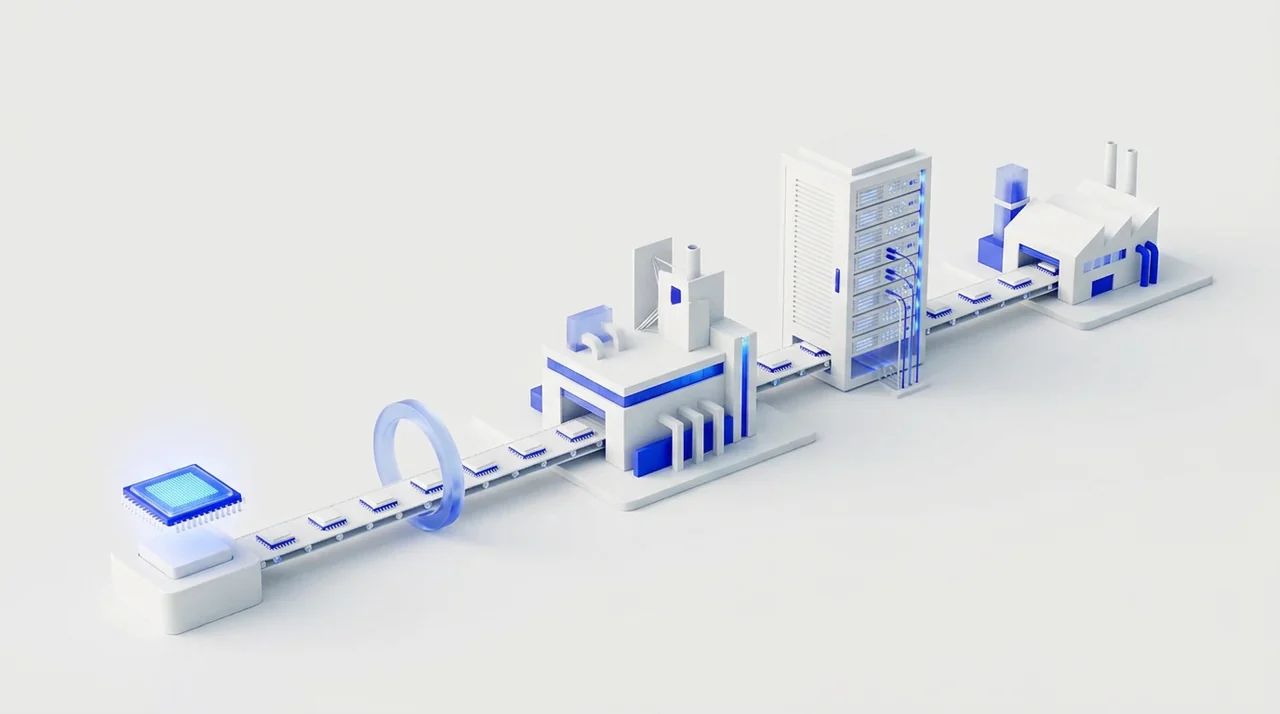
The illustration shows where the check proposed by the Chip Security Act would sit. For your industrial AI project, ask which machines run the service and how your provider documents their provenance.
This also applies to an assistant that searches your machine manuals: ask for supporting documentation, not just a sales promise.
One Negative Consequence: Your AI Services May Depend on the Same Supplier
Patrick Moorhead of Moor Insights & Strategy says, "Every China license now gets read through this story," adding, "Jensen has been Nvidia's lead voice on China, and that voice is weaker," according to CNBC.
This primarily concerns its sales in China. For a French SME, the question is whether its provider could maintain the service through a change at Nvidia.
You can sign contracts with several companies that all use Nvidia chips. You then remain exposed to the same third-party risk.
Hypothetical example: 2 services, a maintenance assistant and a drawing reader, are sold by different companies but run at 1 shared hosting provider, which supplies the machines. If moving each service takes 3 days, followed by 2 days of joint testing, allow 8 days of work in total. This calculation is illustrative, not a quote.
Changing software vendors without changing the machines would leave this dependency intact. Ask for a demonstration of the service on other machines, using your documents, and a cost estimate for the adaptations.
Without prejudging the investigation, ask your provider which machines it uses and which rules actually apply. Then ask: who takes over if your AI service stops?
To examine this dependency based on your actual use cases, let's discuss your AI infrastructure as part of our support for industrial businesses.
Cover photo: Will Buckner, Flickr / Wikimedia Commons, CC BY 2.0 (cropped).